special: tefillin
Flight to Sydney: a true story
Close to twenty years ago, I found myself on the longest flight I had ever taken in my life. For the first time, I was flying halfway across the world to Sydney, Australia, for my brother’s wedding. I had flown east to west first, crossing the continent from the East Coast to California, and from there I boarded a second plane that would carry me all the way to the other side of the world. Fifteen hours. A brutal stretch of time to spend sealed inside a metal tube at thirty-five thousand feet.
Fortune, at least, offered me a small mercy. An emergency exit seat, spacious and unclaimed, and I took it without hesitation. It was only once I settled in that I noticed what came with the territory: the crew seat directly across from me, rear-facing, the way those seats always are in the exit row. Whoever sat there would spend the entire flight looking straight at me.
Flying to Sydney presented a unique challenge for someone who is meticulous about praying three times a day. As our plane pushed westward through the sky, we passed through time zone after time zone, and it took careful planning to determine when exactly to pray the morning prayer, the afternoon prayer, and the evening prayer. The sun did not cooperate with the calendar the way it did on the ground, and so the mind had to do the work the horizon could not.

When the time came for the morning prayer, I rose from my seat, wrapped myself in my tallit, my prayer shawl, and put on my tefillin. Fortunately, there was an open stretch of space near my exit row, and I used it well, praying with focus and intention, the kind of concentration that the stillness of early morning tends to invite even at altitude. When I had finished, I carefully packed away my tallit and my tefillin and returned everything to my seat.
Then, out of the blue, one of the flight attendants came and sat down in the seat directly facing mine. She leaned forward slightly and said, “Sir, I hope you don’t feel I’m being rude, but may I ask you a question?”
“Of course,” I said.
She told me that over the years she had often observed religious Jewish passengers wrapping what appeared to be small black boxes onto their arms and their heads, and she had always wondered what the purpose was. Would I be willing to explain it to her?
“You found the right address,” I told her.
And so, in a way that I hoped was clear and uplifting rather than academic, I explained.
Each morning, I place a small box on my arm, positioned facing my heart. Inside that box is a scroll, and on that scroll are words of the Torah, written as a direct expression of the Almighty’s own instruction. By binding it to my arm, near my heart, I am acknowledging that however many emotions pass through me in the course of a day, whether joy or fear or frustration or longing, there is a higher authority to which I must submit them all.
The second box I place on my head, resting above my brain. That one speaks to the intellect. Whatever understanding I have managed to accumulate in this life, whatever conclusions I have reasoned my way toward, I begin each day by acknowledging that there exists an intelligence far greater than my own. I do not start the morning believing I have figured it all out. I start it with humility.
And whatever the day decides to throw at me, I face it having already reminded myself of what matters most.
She thanked me warmly, and I assumed that was the end of our conversation. I settled back into my seat, content with the small exchange, and let my thoughts drift. But a few minutes later she returned, and what she said next caught me completely off guard.
She explained that over the next hour, the crew would be taking their break and gathering together in the center galley. She had shared what I told her with some of her colleagues, and they were intrigued. Would I be willing, she asked, to come back and give a short presentation to the group?
I paused for a moment. Then I smiled. “Sure,” I said. “Sounds like a nice opportunity.”
About half an hour later she returned and walked me back through the cabin. The galley had been curtained off from the rest of the plane. Inside, the flight crew sat on small crates and fold-out surfaces, several of them eating and drinking, all of them looking up as I entered. She introduced me, I introduced myself, and then I gave them a miniature class, right there at thirty-five thousand feet somewhere over the Pacific Ocean, on the meaning and practice of tefillin.
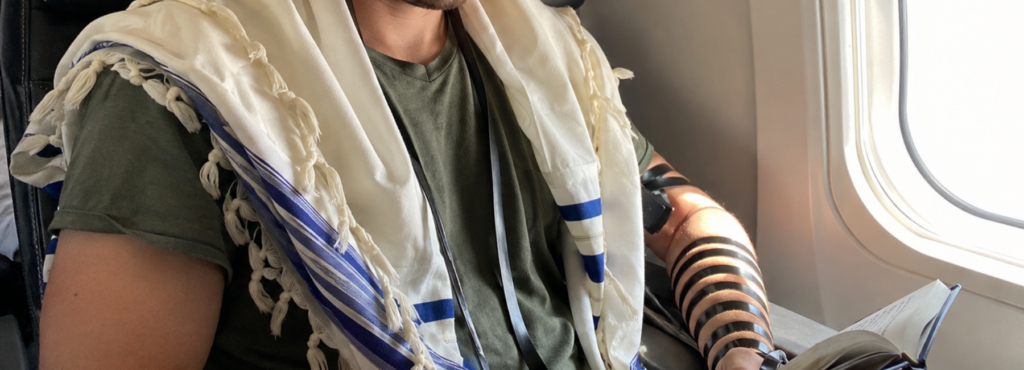
They were genuinely curious. Questions came not only about tefillin but about Orthodox Jewish life more broadly, and I answered each one as honestly and warmly as I could. When it was over they thanked me with real enthusiasm, and I made my way back to my seat, feeling quietly grateful for the unexpected detour.
I assumed, now, that the story had run its course.
It had not.
About two hours before landing, a different flight attendant came and sat down in the seat across from me. She looked at me with an expression that was equal parts earnest and a little nervous, and she said, “Rabbi, that was really interesting. I appreciated your explanation very much.” Then she leaned in slightly and said, “Rabbi, do you do confessions? Because there is something I’ve been wanting to talk about.”
I gave her a gentle smile. “I’m Jewish,” I said, “not Christian. But yes, we do confess. We just go directly to God. We cut out the middleman.” I paused. “I wish you the very best of luck with that.”
She laughed, and so did I.
In this series
I never forgot that flight. Not the eighteen hours, not the time zones, not the curtained galley or the crates or the questions. I never forgot it because it reinforced something I already believed but needed to be reminded of: that my daily commitment to putting on tefillin each morning is something precious. Something singular. When I share it with people who have no connection to it whatsoever, with non-Jews, with secular strangers at thirty-five thousand feet over the Pacific, and they are moved by it, intrigued by it, changed even slightly by hearing about it, then how much more so should I, who holds this practice as a living inheritance, cherish and appreciate the extraordinary gift of tefillin.
How much more so should I appreciate the precious gift that was handed to me.
In this session of Prayer Unpacked, we hope to unpack an integral part of the shacharit experience: tefillin.
It is interesting to note that the Hebrew word most commonly used for prayer is tefilla, almost identical to the word tefillin. Both come from the Hebrew root פ־ל־ל (P-L-L). In Hebrew grammar, lehitpalel is reflexive. It means something closer to self evaluation, inner judgment, or connecting oneself. A person engaged in tefillah/prayer is not only speaking to Hashem. He is also clarifying who he is, what he values, and what direction his life is taking.
Tefilla/prayer is meant to align a person internally:
Tefillin translate those ideas into action through the body itself.
That is why the words emerge from the same conceptual root.
Tefillah is the inward process of alignment and connection.
Tefillin are the outward act that embodies and reinforces that alignment.
One happens internally through words and reflection.
The other happens physically through binding the body itself to that commitment.
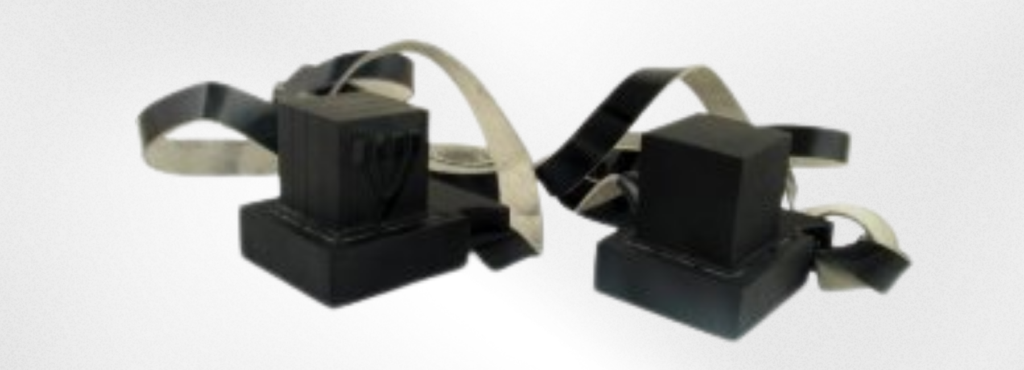
What are Tefillin?
What Is Inside Tefillin?
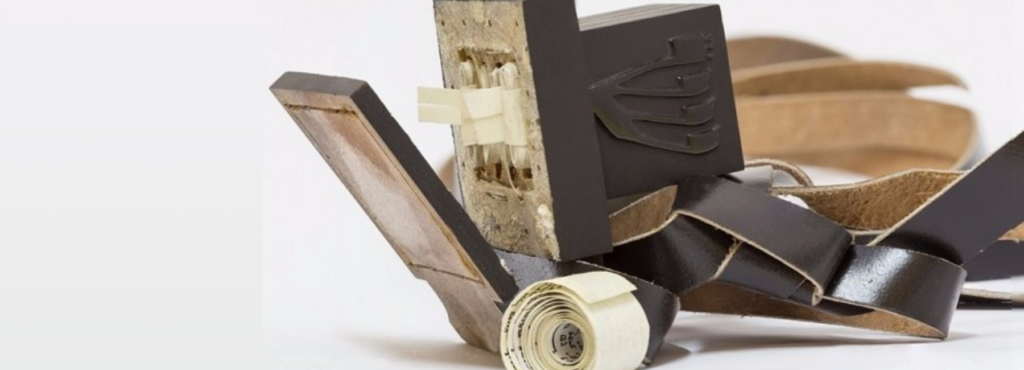
Tefillin consists of two square black leather boxes containing handwritten parchment scrolls with passages from the Torah.
One box, called the tefillin shel yad, is worn on the arm near the heart. The other, the tefillin shel rosh, is worn on the head above the forehead. Attached to each box are long black leather straps.
Inside the tefillin are four Torah sections that express central foundations of Jewish faith:
• The obligation to remember the Exodus from Egypt (Exodus 13:1–10)
• The responsibility to transmit Judaism to the next generation (Exodus 13:11–16)
• The Shema, proclaiming the unity of Hashem and the mitzvah to love Him (Deuteronomy 6:4–9)
• The connection between our choices, our actions, and our relationship with Hashem (Deuteronomy 11:13–21)
The Structure of Tefillin
There are five primary components of tefillin:
• Parshiot – the parchment sections
• Bayit – the box that contains the parchments
• Titurah – the wider base beneath the box
• Ma’abarta – the passageway through which the strap is threaded
• Retzuah – the leather strap (plural: retzuot)
The Name of Hashem on the Tefillin
The outer structure of the tefillin forms the Hebrew letters ש-ד-י, spelling one of Hashem’s names: Shaddai.
• The letter shin appears embossed on both sides of the head tefillin. One side contains a traditional three headed shin, while the other contains a rare four headed shin1.
• The letter daled is formed by the knot at the back of the head tefillin.
• The letter yud is formed by the knot on the arm tefillin near the bicep, where it remains connected to the box itself.
Together, these letters surround the Jew with the Name of Hashem, symbolizing protection, connection, and the binding of one’s mind, heart, and actions to a higher purpose.
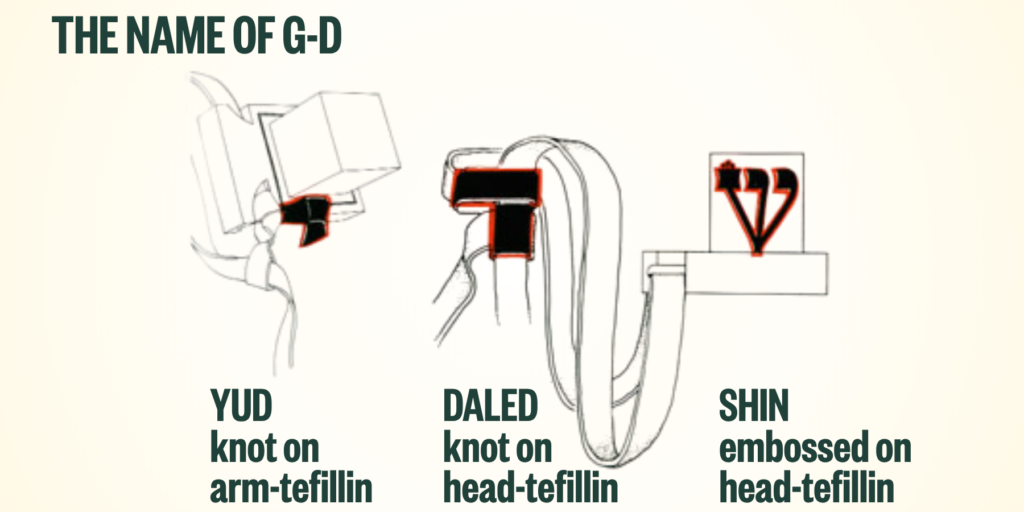
Image from aish.com
The Right Time for Tefillin
The Why
As with all mitzvot/commandments the primary reason for performance is to fulfill the will of the Almighty. If while wrapping and wearing tefillin, one has this singular thought, they have fulfilled the mitzvah of tefillin.
Even so, understanding some of the possible reasoning behind the mitzvah of tefillin gives the wearer a deeper appreciation and understanding of this important mitzvah.
The two tefillin boxes represent the two primary dimensions through which a Jew serves God: thought and action. The head tefillin rests upon the mind, reminding us to dedicate our intellect, perspective, and inner world to the service of the Almighty. The arm tefillin is bound upon the arm, symbolizing the commitment to channel our strength, abilities, and actions toward fulfilling God’s will.
The arm tefillin is specifically placed opposite the heart. Its location teaches a profound lesson: if the heart and mind are disconnected, our service becomes fragmented. True spiritual growth occurs when our emotions, values, and actions are aligned with the clarity of our thoughts and beliefs.
There is another striking distinction between the two tefillin. The arm tefillin contains a single parchment housed within one compartment, while the head tefillin contains four separate parchments placed into four distinct compartments. This difference emerges directly from the Torah itself, which refers to the arm tefillin in the singular form, “ot,” while describing the head tefillin with the plural term, “totafot.”
The symbolism is powerful. A person must use the full complexity of the mind, exploring ideas from every angle and developing a broad understanding. But once clarity is achieved, action must become singular and focused. We think expansively, but we live decisively.
This may also explain why the arm tefillin is placed on before the head tefillin. Judaism does not view Torah as merely an abstract intellectual pursuit reserved for theoretical discussion. Torah learning is meant to shape the way we live. Commitment to action must come first. Only afterward do we build the intellectual framework that deepens and elevates those actions.
The How
How to Put on Tefillin
The arm tefillin is placed on first, following the order in which the Torah presents the mitzvah: “Bind them as a sign upon your arm, and they shall be totafot between your eyes.”
To begin, open the tefillin bag zipper and remove only the arm tefillin first.
Unwrap the strap gently, making sure it does not touch the floor. Many people have the custom to kiss the tefillin before putting them on.
There are different traditions regarding posture. Ashkenazim generally put on both tefillin while standing, while many Sephardim sit for the arm tefillin and stand for the head tefillin.
The arm tefillin is placed on the center of the bicep of the weaker arm, tilted inward toward the heart. A right handed person places it on the left arm, while a left handed person places it on the right. Nothing should separate the tefillin box from the skin (roll up your sleeve if necessary).
Once the box is in position, but before tightening the strap around the arm, the blessing is recited.
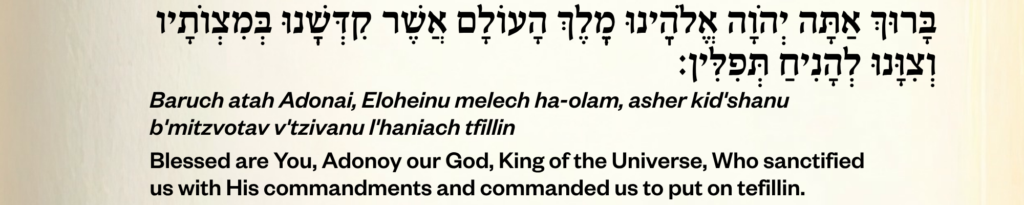
After the blessing, the strap is wrapped around the forearm seven times. The black side of the strap should always face outward. Different customs exist regarding the direction in which the strap is wound.
At this stage, the strap is not yet wrapped around the fingers. Instead, the remaining strap is loosely secured around the palm or wrist while preparing to put on the head tefillin.
From the moment the blessing on the arm tefillin is recited until the head tefillin is in place, one should avoid interruptions such as speaking, gesturing unnecessarily, or responding to parts of the prayer service.
Putting on the Head Tefillin
The head tefillin is placed above the forehead, resting entirely within the natural hairline. Someone who is balding should place it where the hairline once was.
The knot of the head tefillin rests at the back of the head, just above the hairline on the nape of the neck. Both the box in front and the knot in back should be centered precisely.
The straps should hang down evenly in front of the body, with the black side facing outward.
Before placing the head tefillin on the head, it should be held in position respectfully and not allowed to dangle. Ashkenazim recite a second blessing immediately before placing it on the head, followed by “Baruch Shem” once it is secured in place. Sephardim generally do not recite a second blessing unless there was an interruption after the first blessing.
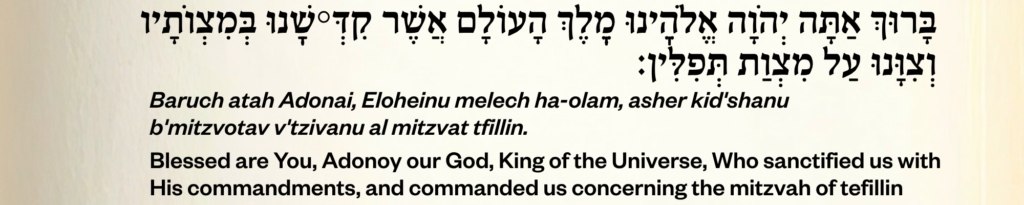
After both tefillin are properly in place, the strap of the arm tefillin (which was left loosely wrapped upon the hand) is now wrapped around the hand and fingers according to one’s custom.
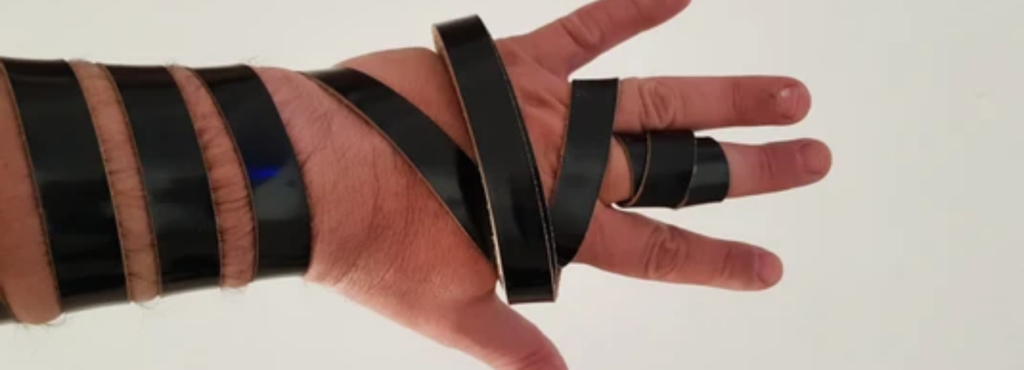
Many have the custom at this point to recite the verses from Hoshea describing the eternal bond between God and the Jewish people:
“I will betroth you to Me forever. I will betroth you to Me with righteousness, justice, kindness, and mercy. I will betroth you to Me with faithfulness, and you shall know God.”
After the morning prayers are completed, the tefillin are removed while standing. The head tefillin is removed before the arm tefillin. Many people kiss their tefillin before placing them back in the bag as an expression of love for the mitzvah.
One Final Idea
While our Tefillin express our love and devotion to God, that love is returned in kind. The Sages teach that God Himself “wears” Tefillin, upon which is inscribed His love for the Jewish people: “Who is like Your people Israel, a unique nation on earth” (I Chronicles 17:21). Of course, this is not meant literally. God is beyond physical form.
Rather, the imagery conveys the profound bond between God and His people.
Throughout Jewish history, Jews have risked everything for the privilege of putting on Tefillin. Even in the darkest moments of the Holocaust, the mitzvah remained a lifeline of faith and identity. Rabbi Yehoshua Aronsohn, in The Holocaust and Halakhah, describes the scene in Auschwitz:
When we arose in the darkness of the night, we had just managed to wash, the block leaders and their helpers were hurrying us along to the forced-labor details. There were long queues of prisoners waiting in line, not for bread or coffee, but to fulfill the mitzvah of Tefillin. We appointed a special “guard” whose job it was to make sure that no one kept the Tefillin on for longer than it took him to say the one verse “Shema Yisrael,” so that more would be able to fulfill the mitzvah.
Tefillin embodies the deepest closeness between a Jew and God. It is the true source of Jewish strength and dignity. About Tefillin, the Torah declares: “All the nations of the earth will see that the Name of God is called upon you, and they will stand in awe of you” (Deuteronomy 28:10).
Limited Offer
As part of the Prayer Unpacked program, we are excited to offer a special opportunity.
If you have never owned a pair of Tefillin and are committed to putting on Tefillin daily, a generous donor has agreed to sponsor a limited number of pairs for qualified participants.
If this applies to you, please reach out to slandau@olami.org for more details.
1 The Zohar teaches that Tefillin correspond to the entirety of the Torah, and that all 613 mitzvot are hinted to within the two shins embossed on the head tefillin.
Here is how:
The Hebrew letter shin has the numerical value of 300. Since there are two shins, together they equal 600.
In addition, the two shins form the Hebrew word שש (sas), a word associated with joy, reminding us that mitzvot are meant to be performed with happiness and vitality. Using the system known as mispar katan (“small numerical value”), the word שש carries the value of 6.
Finally, if you count the total number of branches on the two shins, one with three heads and one with four, they add up to 7.
Together the numbers form a remarkable total:
600 + 6 + 7 = 613
An allusion to the 613 mitzvot of the Torah, all contained symbolically within the tefillin themselves.
2 While tefillin are typically worn at shacharit, technically one can wear tefillin at any point during the day time. (Many beginners start their tefillin journey by taking just a few moments each morning to wrap tefillin and recite the shema.)