Session 7: Ma’ariv (Evening Prayer)
Burst of tefilla inspiration
Freed hostage Or Levy shared the following about the period of his imprisonment. In his words:
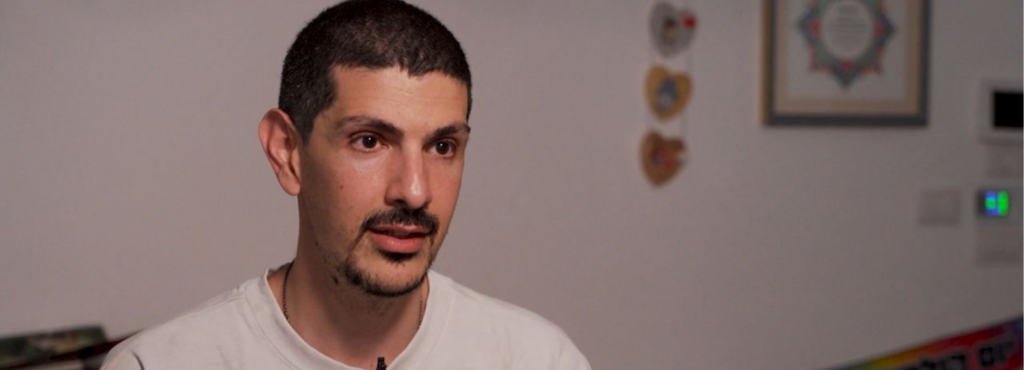
And then you start counting. Counting the seconds, the minutes, the hours.
If you’re lucky, they’ll give you food in 24 hours. If you’re lucky.
Before October 7, I wasn’t really a big believer in G-d.
And one should assume that when you’re there, in a living hell. You would lose the little belief that you had, but for me it was the opposite.
At first when we were in an apartment, I used to pray to a crack of light in the ceiling. I used to call it “the crack”. And then we got into the tunnel and I switched from praying to the crack to praying to an LED light, a small LED light that was left on.
And then we got to a different tunnel. Then there was only darkness.
And this is when for the very first time, I said the word G-d. And from that point on, I spoke to G-d.
You know, it was very hard there… Hard doesn’t even begin to cut it.
But whenever it became, let’s say, too hard, whenever I told myself enough, I would talk to G-d, ask Him for something… I would ask him to save us.
And you know that mostly every time that I felt like it was too much, I prayed and then, something did happen. It could have been one pita divided by four. It could have been a cup of tea, which means nothing to most of you.
But when you’re there, it can change how you see a day from the worst to the best.
And when you’re there, the little wins are what you need, are what help you get through the day.
So yeah, I think I have discovered belief now.
In three different cases that I can tell specifically, I accepted death, and I said Shema Yisrael. I don’t know why I said it, to be honest. I don’t know….

When Or (meaning light!) Levy described how, in the tunnels of Gaza, he moved from praying to a crack of light to praying to an LED bulb, and finally to praying in utter darkness, he unknowingly described the very soul of Maariv; the evening prayer.
Our morning and afternoon prayers correspond to times of light, clarity, movement, and visibility. But Maariv was born in darkness. It is our patriarch Yaakov’s prayer; the prayer of night, of exile, of uncertainty. Unlike Shacharit and Minchah, which were obligatory and structured around offerings in the Beit HaMikdash/The Temple, Maariv began as a voluntary prayer, because faith in the darkness cannot be commanded. It has to be chosen.
In the tunnels of fear and silence, Or Levy discovered that even in total darkness, one can still talk to G-d.
That moment, when he could no longer see even the smallest flicker of light, is when he first said “G-d.”
That is Maariv, the prayer of the unseen, a whisper in the darkness, it’s a voice that keeps speaking when there is nothing visible to hold onto.
When we pray Maariv, we are not only reciting words, we are choosing to believe that G-d is present even when the world feels hidden. We are affirming that the light may be gone from our eyes, but not from our souls. And perhaps that’s why, near the beginning of maariv, we say:
“גולל אור מפני חשך וחשך מפני אור”
“The Almighty rolls away light before darkness and darkness before light.”
Even as the night falls, we declare that the cycle is not random, that darkness and light both move by His design. We carry the crack of light, the LED, the memory of the dawn within us.
Maariv is the prayer of those who have learned, like Or Levy, that belief doesn’t disappear in the darkness, it’s often discovered there.
In this series
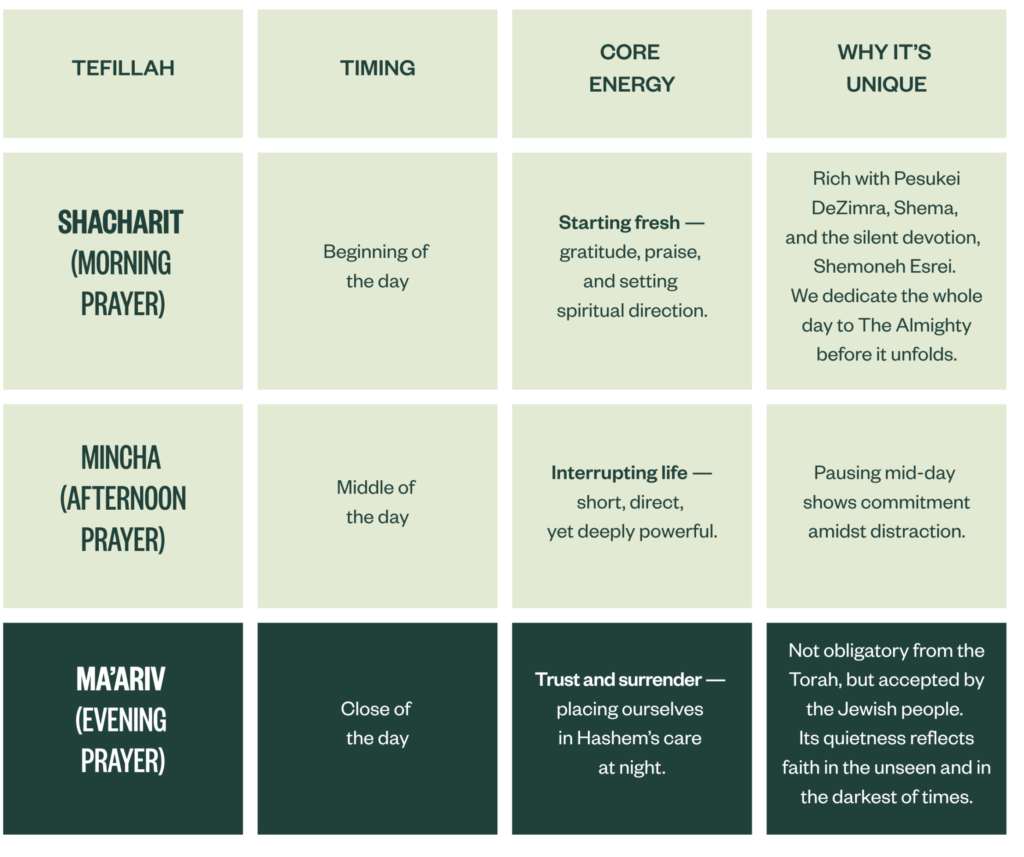
The Three Daily Tefillot:
An Arc of Connection
the structure
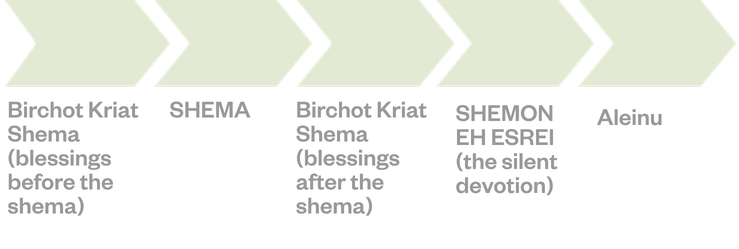
It is worthwhile to take a moment and focus on the second of the two brachot/blessings that precede the shema.
Here is the short but powerful bracha of Ahavat Olam1:
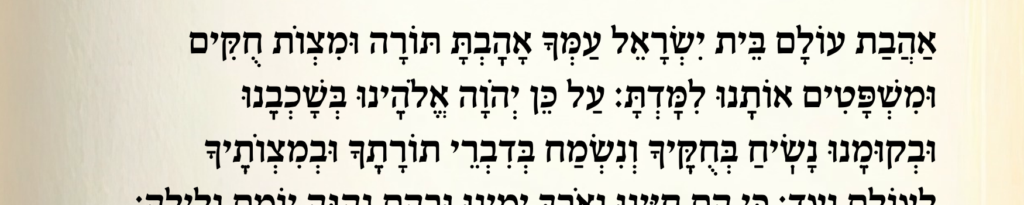
With an everlasting love You loved Your nation the House of Israel. You taught us Torah and commandments, statutes and laws. Therefore, Hashem, our G-d, when we lie down and when we arise, we will discuss Your statutes, and rejoice in the words of Your Torah and in Your commandments forever. For they are our life and the length of our days, and on them we will meditate day and night. May Your love never be removed from us forever. You are the source of blessing, Almighty, Who loves His nation Israel.
Here is a better understanding of its content and location in the prayers.
If Maariv begins with darkness, then Ahavat Olam, the second blessing recited before the shema, is the discovery of light within it. After we acknowledge that G-d rolls light and darkness in perfect rhythm, we immediately speak of His eternal love “אַהֲבַת עוֹלָם בֵּית יִשְׂרָאֵל עַמְּךָ אָהַבְתָּ.” “Almighty you love the Jewish people with eternal love.” It is as if, in the stillness of night, Hashem whispers: “You are not alone. My love is still here.”
At night, we cannot see. The clarity of the day, our plans, our confidence, and our understanding fades. What remains is memory and faith.
And it is precisely there that we remind ourselves of the greatest expression of that love: the gift of Torah. In darkness, Torah becomes our beacon.
King Solomon in proverbs calls Torah “אור,” light. But it is not the light of day, it is the steady, enduring light that burns even when the sun sets. It is the light that has guided generations through exile, that has kept our people alive in tunnels of fear, in ghettos and camps, in all the long nights of history. The Torah is not a searchlight that eliminates darkness; it is a lamp that teaches us how to walk within it.
And so we begin Maariv with Ahavat Olam, to remind ourselves that even when everything familiar disappears, Hashem’s love does not. His Torah continues to speak, to comfort, to illuminate the next step. For those who, like Or Levy, found G-d in the darkness, this prayer is the song of that discovery: that in every night, there is a light that never fades, the light of His eternal love, shining through the words of His Torah.

One final note about Maariv, it is the prayer of completion. While the day’s work and noise subside, Maariv gathers all its fragments, the moments of clarity, the struggles, the triumphs, and even the confusion and offers them back to Hashem.
And then near the end of Maariv, comes Modim, the prayer of thanksgiving. We say it every day, and in every service, yet at night it carries a special resonance.
Modim at Maariv invites us to pause and look back over the day now drawing to a close. It’s the moment when gratitude becomes personal, not a general acknowledgment of blessings, but a quiet conversation of thanks for the specific moments of kindness, protection, and joy that filled this day. In the stillness of evening, when the rush has faded and reflection becomes possible, Modim transforms from recitation to recognition: that through every moment of that unique day, The Almighty’s hand was present, guiding us gently toward another dawn.