Session 9: Shacharit on Shabbat
Burst of Inspiration
Here is a beautiful story about the power of prayer and Shabbat.
Daniel was a struggling ten year old child attending a Jewish day school.
Every morning he would arrive at school and open his Mishna (the oral law in Hebrew). And every morning he failed to comprehend the material taught.
He had a hard time reading Hebrew and simply could not follow the lessons. While the other boys asked, answered, argued, and learned, Daniel sat still, silent, distant, unmoving. His parents took him to learning specialists. They hired tutors. They searched for diagnoses, explanations, and solutions. Nothing worked.
Daniel’s house filled with quiet pain, the kind that doesn’t scream out loud but never leaves. His mind and heart, it seemed, simply would not open.
Then one day, seemingly out of the blue, his teacher noticed something small.
It seemed like Daniel was listening.
Not drifting. Not staring. Listening. A day later, he raised his hand. Soon after, he asked a question. A solid question. Slowly but surely, Daniel progressed, steadily, unmistakably.
The change was so pronounced that his teacher called his mother.
“What happened?” he asked.
“What changed? Does he have a new tutor? Medication?”
Daniel’s mother was silent for a moment. Then she said, “I’ll tell you the truth.”
For months, she explained, her son had been crying to her at night. Not complaining. Crying.
He wanted to understand. He wanted to learn. He wanted to be like the others. Yet, each night he asked the same question.
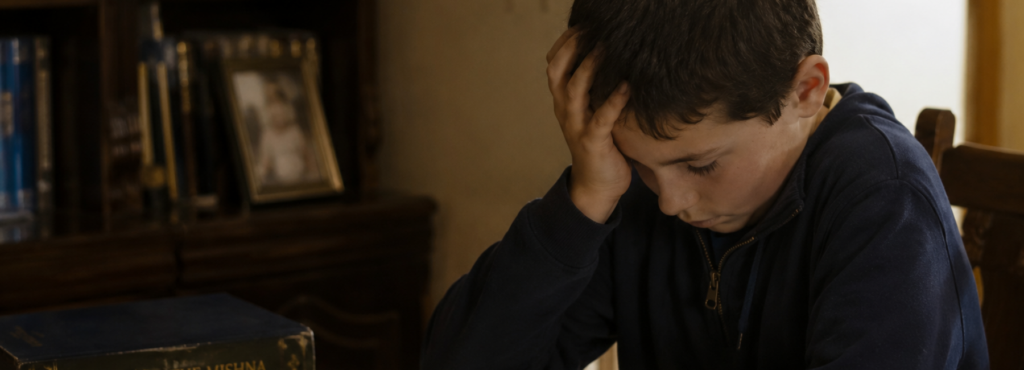
“Why is my mind closed? Why can’t I learn?”
One evening, at wits end his mother suddenly had an idea.
“Every Friday night,” she said, “I light Shabbos candles. It’s a moment when tefillot (prayers) go straight to heaven. From now on, I am dedicating that very special moment just to pray for you.”
She asked him to stand beside her.
That Friday evening, after she lit the candles, she covered her face and began to sob softly. Daniel, seeing his mother crying, cried too. Deep, shaking sobs. No words. Just tears. Mother and son standing together, pouring out what they could not explain, asking Hashem for one thing alone, that his heart be opened to understanding Torah.
They did it again the next week.
And the next.
And the next.
For many weeks, the routine continued. No words. No explanations. Just heartfelt prayer.
Slowly, something in Daniel began to change. He started paying attention in class. He began to follow the lessons and understand what was being taught. Bit by bit, he began to grasp the material. Not suddenly, but steadily. Until one day, learning was no longer a struggle. It had become something he could engage with fully, a source of confidence and joy.
His mother realized what had made the difference. The moments they shared at the Shabbos candles, the tears and the prayers, had reached Daniel in a way nothing else could.
There is a unique power in Shabbat prayer, a quiet time when hearts are open and intentions are clear. Those moments of focus and devotion, offered with sincerity, had helped open his mind and strengthen his spirit, guiding him toward understanding and growth.
In this series
Shacharit on Shabbat is a special and elevated time for tefillah. It is longer than a weekday Shacharit, but as we often say, there is nowhere else to rush off to. It is the one morning each week when we can truly invest in Shacharit and daven with calm, focus, and concentration.
On Shabbat morning, Pesukei Dezimra is expanded with a rich collection of additional tefillot. The blessings preceding Shema are enhanced, and the Shemoneh Esrei itself is entirely unique to Shabbat. We then read from the Torah, followed by a passage from the Prophets. Finally, the tefillah concludes with a special additional Shemoneh Esrei, known as Mussaf, completing the fullness and depth of Shabbat morning prayer.
Structure

I. P’sukei Dezimra
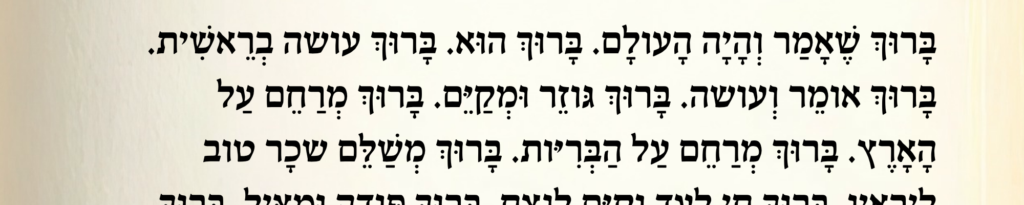
On Shabbat, Pesukei Dezimra is expanded to reflect the added holiness and serenity of the day. The additional chapters are not meant to rush us toward the formal prayers, but to gently elevate us into a deeper state of praise and awareness of Hashem. Shabbat itself testifies to creation and divine mastery over the world, and these added selections give voice to that testimony, allowing us to linger in gratitude, awe, and joy before standing in tefillah.
These extra selections also set a different tone from the weekday. During the week, Pesukei Dezimra helps us transition from the busy nature of life into prayer. On Shabbat, when external pressures fall away, the added Pesukei Dezimra allows the soul more time to breathe and expand. It creates space to slow down, reflect, and truly praise Hashem, so that when we reach Shema and Shemoneh Esrei, our hearts are already aligned with the sanctity and peace of Shabbat.
P’sukei Dezimra concludes with a prayer called Nishmat. Nishmat is the crown jewel of Shabbat Pesukei Dezimra, a soaring expression of gratitude that acknowledges the limits of human praise. We declare that even if our mouths were filled with song like the sea and our lips with praise like the endless waves, we could never fully thank Hashem for His kindness.
Nishmat captures the spirit of Shabbat itself: a day when we step back from doing and focus on recognizing, appreciating, and proclaiming Hashem’s constant presence and goodness in our lives.
II. Birchot Kriat Shema (blessings before the shema)
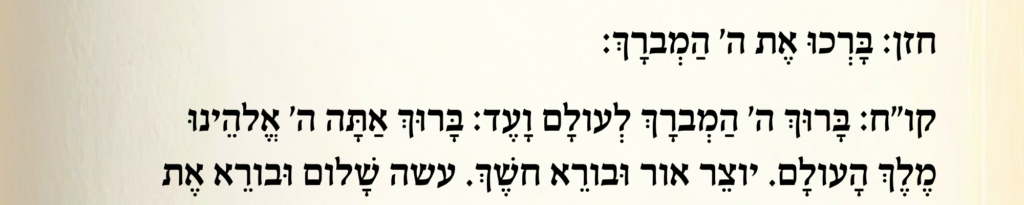
The Birchot Kriat Shema of Shabbat reflect the unique light and serenity of the day. Unlike the weekday blessings, which emphasize ongoing creation and divine kindness in a world of effort and struggle, the Shabbat blessings highlight rest, harmony, and a deeper revelation of Hashem’s unity. They include the beautiful song Kel Adon, which joyfully celebrates Hashem as the eternal master of all creation. These berachot prepare us to recite Shema on Shabbat with a heightened sense of closeness, calm, and awareness of Hashem’s presence.
III. Shacharit Shemoneh esrei
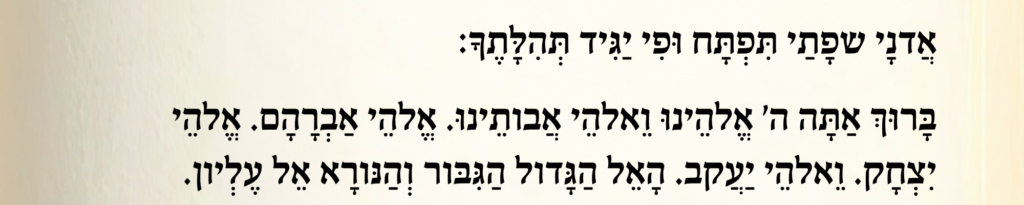
The Shabbat Shacharit Shemoneh Esrei is different from the weekday prayer. Instead of asking for personal needs, it focuses on praising Hashem and honoring the special holiness of Shabbat. The words celebrate creation, Hashem’s kingship, and His covenant with the Jewish people. Praying this Shemoneh Esrei helps us connect to the peace and joy of Shabbat and feel closer to Hashem.
IV. Torah Reading & Haftarah
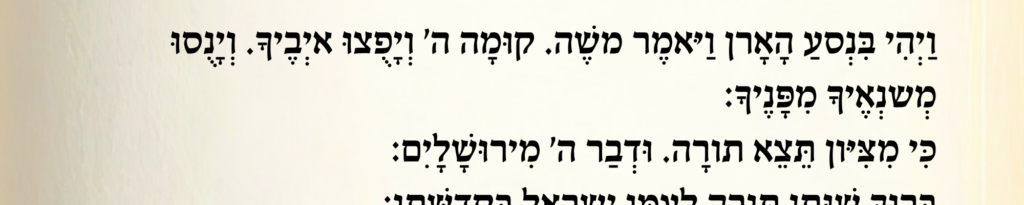
The Shabbat Torah reading is a central part of the morning service, bringing the words of the Almighty directly to the community. Each Shabbat, we read a special portion from the Torah, allowing everyone to hear and connect with the weekly message. This reading is followed by a section from the Prophets, called the Haftarah, which complements the Torah portion and highlights its lessons.
(See session 10 for a more comprehensive understanding of the concept of Torah reading.)
V. Yekum Purkan and Av Harachamim 1
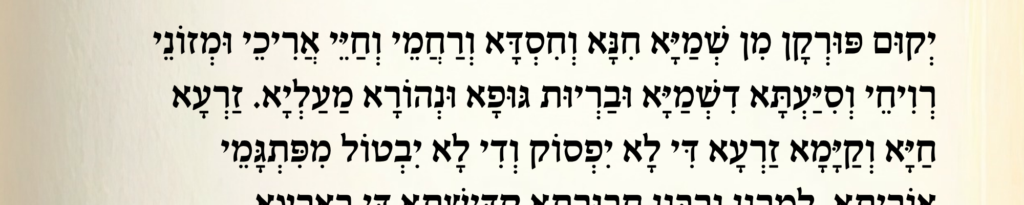
These prayers are recited after the Torah reading, before Mussaf. Yekum Purkan asks for the welfare and success of Torah scholars, yeshivas, and the Jewish community, connecting us to the ongoing continuity of Torah study. Av Harachamim honors the memory of Jews who were martyred for their faith and prays for mercy and protection for the Jewish people. Together, these prayers remind us of our communal responsibilities, our spiritual heritage, and the importance of remembering both the living and the fallen in our prayers.
VI. Ashrei
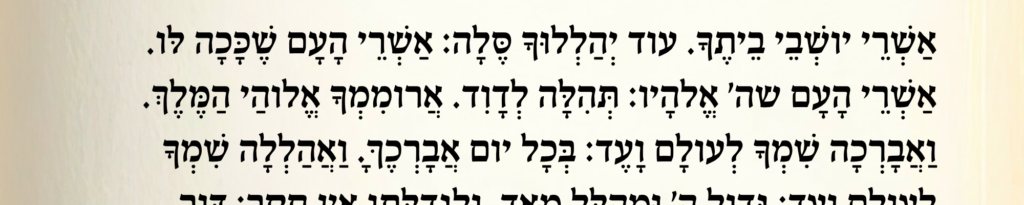
Ashrei is traditionally recited before the mussaf shemoneh esrei because praise should precede prayer.
VII. Mussaf Shemoneh Esrei
Similar to the standard shemoneh esrei, the Mussaf shemoneh esrei begins with three blessings of praise and ends with a blessing for gratitude and peace.
The body of the mussaf shemoneh esrei focuses entirely on the sanctity of Shabbat and the additional Shabbat Temple offerings. It opens by affirming that Hashem lovingly gave Shabbat to His people as a day of rest and holiness, recalling that it is a remembrance of creation and a sign of the eternal covenant between Hashem and Israel. The prayer then describes the mussaf sacrifice that was offered in the Temple on Shabbat, expressing longing for its restoration and for our service to be accepted once again. It contains no personal requests, only praise, sanctification of the day, and devotion, and it concludes by blessing Hashem as “Mekadesh HaShabbat”, the One Who sanctifies Shabbat.
VIII. Ein Kelokainu
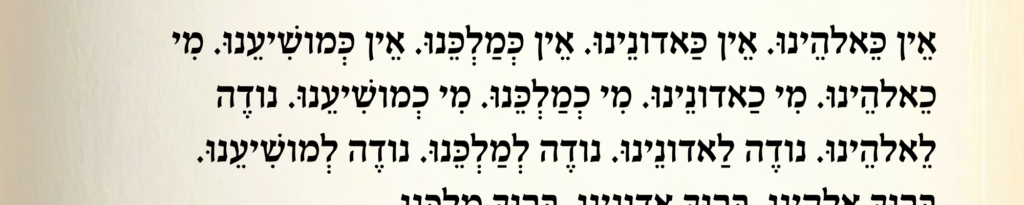
Ein KeElokeinu is a poetic declaration of faith built on four escalating affirmations: Ein ke’Elokeinu – There is none like our God,
Ein ke’Adoneinu – None like our Master,
Ein ke’Malkeinu – None like our King,
Ein ke’Moshieinu – None like our Savior.
It then mirrors each statement with a response of “Mi ke’Elokeinu…” – Who is like our God – and concludes with “Ata Hu…” – You alone – affirming that Hashem alone has always been and always will be.
Ein KeElokeinu is designed to complete the liturgy of Shabbat: On weekdays the shemoneh esrei has 19 blessings, while on Shabbat it is shortened to 7. The 12 verses of Ein KeElokeinu serve to compensate for the missing praises.
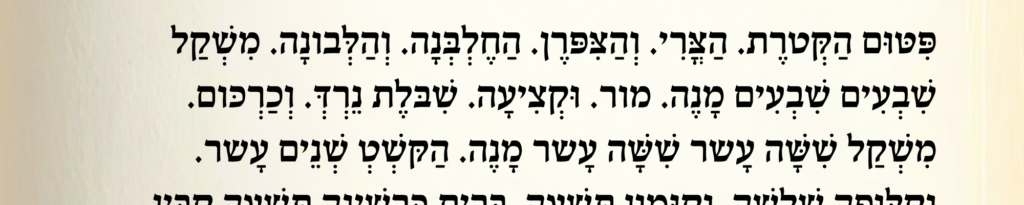
Pitum HaKetores refers to the precise text, quantities, and method for preparing the incense that was offered on the Golden Altar in the Holy Temple. Reciting the text of the incense is considered, in a sense, equivalent to offering it in the Temple, as the Sages derive from the verse, “Instead of sacrifices we will pay
the offering of our lips.” (Hosea 14:3).
Since we are unable to perform the Temple service today without the Temple, we fulfill the mitzvot symbolically by mentioning them at their proper time in prayer. Saying the words of Pitum HaKetores is thus seen as a verbal offering, connecting us spiritually to the Temple service even in its absence 2.
The Zohar (textbook of Kabbalah) emphasizes that by reciting the incense with proper intention, a person is protected from all kinds of calamities, afflictions, and harsh judgments.
IIX. Aleinu and the Yom (Final prayer and the daily chapter)
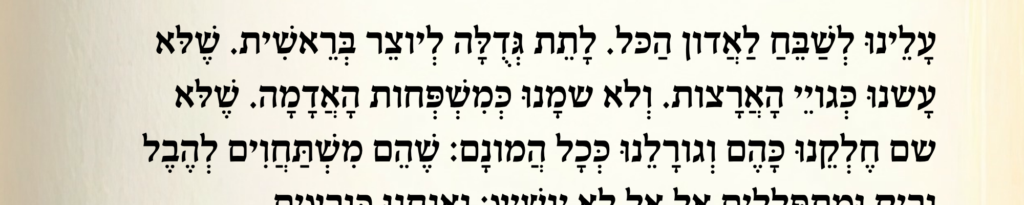
Similar to shacharit each day, the service concludes with the aleinu prayer and the daily chapter of Psalms (See session 5).
The Psalm for Shabbat is Psalm 92, known as Mizmor Shir LeYom HaShabbat, or “A Song for the Sabbath Day.”
Interestingly, the psalm does not narrate the events of Shabbat itself. Rather, it reflects on the spiritual essence of the day, emphasizing gratitude, faith, clarity of mind, and the recognition of God’s perfect governance over the world.