Session 6: Mincha (Afternoon Services)
Burst of tefilla inspiration
The closing was supposed to be routine, or as routine as a complex real estate deal could get. Lawyers from both sides filled the seller’s office, documents stacked, pens poised, phones buzzing. Tensions ran high; every word, every number seemed to matter more than the last.
Yet, in the middle of the flurry, something remarkable happened. One of the home team lawyers glanced at the clock. “Mincha,” he said quietly. Without hesitation, the majority of the home team lawyers all set aside papers and joined the daily Mincha minyan held in the office. It was brief, unassuming, yet profoundly grounding a pause in the storm to remember what truly mattered.
The closing continued for quite a few days with the daily pause for the mincha minyan.
That rhythm was suddenly interrupted one day. When those fellows abruptly closed their laptops and headed for the doors.
“Where are you going?” someone asked, bewildered.
“Today is a fast day, and there’s no Torah scroll in the office today. On fast days, Mincha includes a Torah reading. We’re heading to a synagogue.”

The visiting team watched them leave, impressed, but mostly puzzled. Months passed. The deal closed. Life returned to its usual chaos.
Then came the invitation, the senior partner on the visiting side asked the senior partner from the home team to come over to his home.
When he arrived, he froze. There, displayed in a place of honor, was a Torah scroll.
“You were so devoted to Mincha,” the visiting senior partner said softly, “I couldn’t bear the thought that you wouldn’t have a minyan on location just because there wasn’t a Torah scroll. So here it is… it’s for you.”
The lawyer stood speechless. He realized this was not about business, contracts, or even custom; it was about respect, devotion, and faith carried through ordinary life.
That Torah scroll became more than a scroll. It was a reminder that faith in action, even a short pause for Mincha, can ripple outward in ways no one can anticipate, turning moments of devotion into acts that inspire, protect, and endure.
In this series
The Three Daily Tefillot:
An Arc of Connection
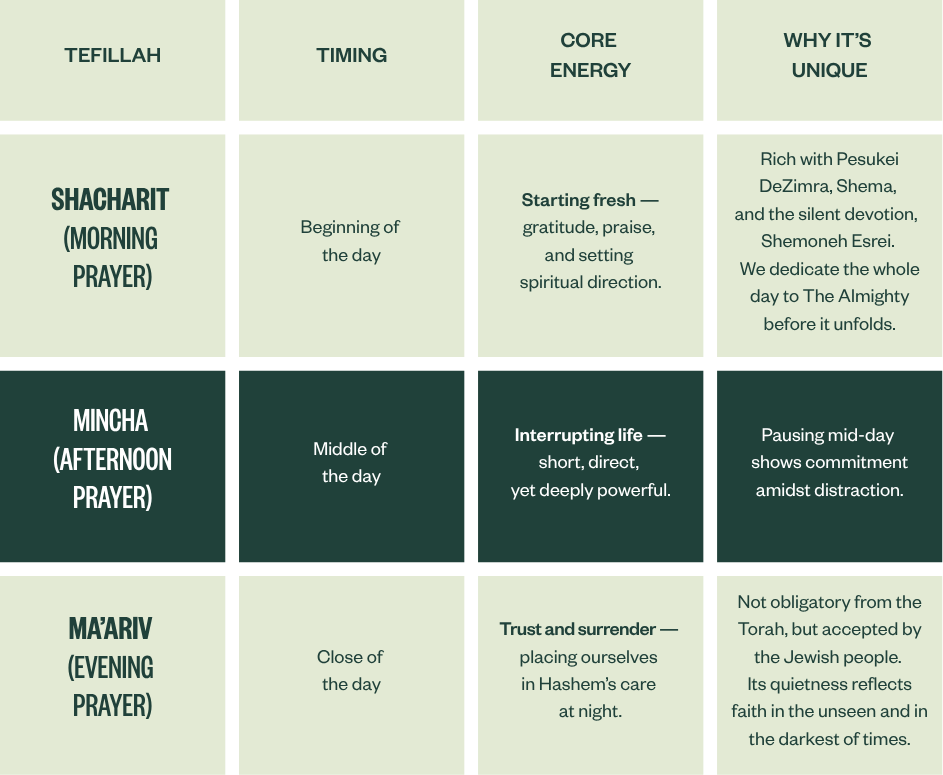
the structure

Ashrei1 Power
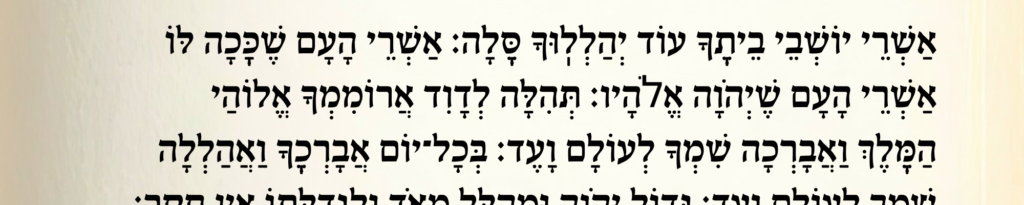
- The Talmud makes an astounding statement about the impact of reciting Ashrei:
Rabbi Elazar said in the name of Rabbi Avina, “Anyone who recites Ashrei (Psalm 145) three times a day is assured of a place in the World to Come.”
(Talmud, Berachot 4b)
- The Talmud then explains that this remarkable promise is due to two unique features found in Ashrei:
- Ashrei follows the order of the Hebrew alphabet, with each verse beginning with a different letter; a poetic expression of structure and completeness.
- It contains the verse, “You open Your hand and satisfy the desire of every living being,” recognizing that every form of life is sustained by The Almighty; the single source of generosity.
- These details are beautiful, but they also invite two profound questions:
- How could the simple, daily recitation of an ancient psalm, however poetic, possibly guarantee a share in eternity?
- And why are these two specific qualities of Ashrei considered so powerful that together they open the gates to the world to come?

- The Maharsha (Rabbi Shmuel Eliezer ben Judah HaLevi Eidels, 1555–1631), a renowned Talmudic commentator, offers a striking explanation. He writes that the Hebrew alphabet represents order, the structure, design, and perfection that underlie creation, and the verse, “You open Your hand and satisfy the desire of every living being,” expresses the ongoing flow of kindness and sustenance that keeps creation alive.
When a person recognizes both the world’s inherent order and its constant generosity, they affirm two fundamental truths. The Almighty as Creator, who shaped the universe with purpose and harmony. The Almighty as Sustainer, who continually provides for all life.
Living with this awareness and focusing on it throughout the day shapes a life in which mind and heart are aligned. Such a person, says the Maharsha, does not only earn a share in eternity, they begin to experience it in the way they see and live each moment.
- One final point: The Message of the Missing Letter
If you ever read the Hebrew prayer Ashrei, you might notice something curious. It’s an alphabetic psalm, each line begins with a different letter of the Hebrew alphabet, except one: the letter “Nun” is missing.
Why would King David, Israel’s great poet and songwriter, leave out a letter?
The Rabbis in the Talmud noticed this too. They explained that the letter Nun is at the start of the Hebrew word “nefilah,” which means falling. In the book of Amos, the word appears in a verse describing the people of Israel who have fallen and cannot rise. David didn’t want this psalm, a song of hope and gratitude, to include even a hint of despair. So he left that letter out.
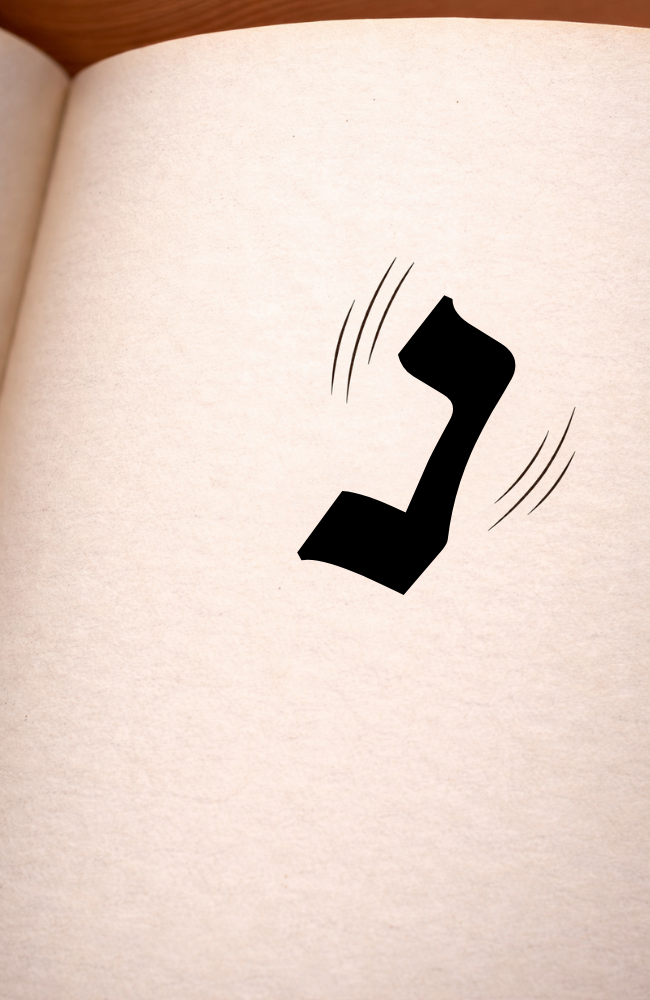
But then, immediately after skipping Nun, the subsequent letter, Samech, includes this line:
סוֹמֵךְ יְהוָה לְכָל־הַנֹּפְלִים
“The Almighty supports all who fall.”
It’s as if David is saying: Yes, we fall. We all do. But no fall is final.
Right in the space where the Nun should have been, the space that represents failure, David placed the reminder that God is already there, lifting us up.
Our Mystics saw something profound in this. The missing Nun isn’t really gone. It’s just hidden inside the word hanoflim; “those who fall.” It’s the sacred idea that even in our weakest, most uncertain moments, we are not alone.
There is, however, one additional mystical layer, the letter Nun has the numerical value of fifty, which represents the highest level of spiritual understanding; a level beyond what humans can reach. So maybe the missing Nun teaches that some truths about God’s support are beyond what we can explain, but not beyond what we can feel.
Ashrei’s missing letter becomes a message of comfort.
Falling is part of life. So is being lifted.
The Nun may be absent from the text, but it’s present in the experience, and constantly reminding us that every stumble is an invitation to discover how deeply we are held.
Perhaps that is the quiet miracle of Mincha, the briefest of the daily prayers, yet the one that most reveals who we truly are. It meets us not in the calm of morning or the stillness of night, but in the middle of life’s noise and deadlines, when faith requires interruption.
To pause then, to say Ashrei and remember both the world’s order and its generosity, is to declare that even in the busiest hours, the Divine still pulses beneath it all. Like the lawyer who stopped mid-closing or King David who found holiness even in a missing letter, Mincha reminds us that the sacred can emerge in the center of the ordinary, and that every small act of devotion has the power to turn a fleeting moment into eternity.
1 Pg. 232 in the ArtScroll Wasserman Edition Siddur